
Frequency of Compounding and Effective Rates

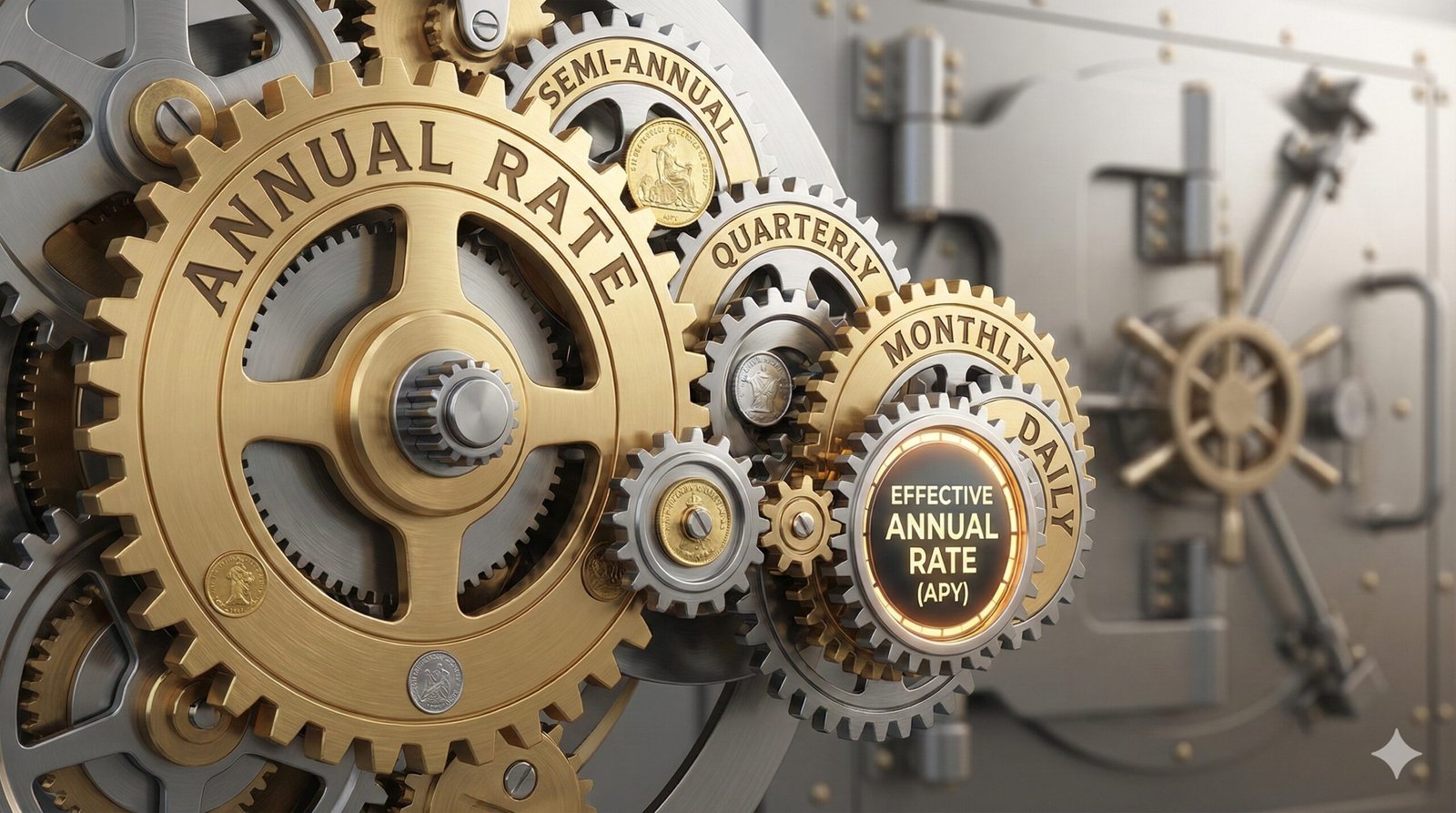
1. What is Frequency of Compounding? Why Does It Matter?
When we talk about interest rates—whether for a savings account, a bond, or a loan—we often see an annual percentage rate (e.g., “10% per year”). However, the frequency of compounding tells us how often that interest is actually calculated and added back to your balance.
While a standard rate might be quoted annually, the bank might pay you interest every six months (semiannually), every three months (quarterly), or even every day (daily).
It matters because of the “snowball effect” of compound interest.
- If interest is compounded more frequently, your interest earns interest sooner.
- Over time, this results in a higher total return than if interest were calculated only once a year.
- For a borrower, it means paying more; for a saver, it means earning more.
2. Numerical Example and General Formula
Let’s look at how this works with a concrete example. We will move away from the simple annual model and look at quarterly compounding.
The Scenario
Suppose you invest $5,000 in a high-yield account paying an annual interest rate of 6%. However, the bank credits interest to your account quarterly (4 times a year).
Since the annual rate is 6%, the rate applied every quarter is not 6%, but rather the annual rate divided by the number of periods:
$$
\text{Rate per quarter} = \frac{6\%}{4} = 1.5\%
$$
Step-by-Step Growth
First Quarter (First 3 months):
You earn 1.5% on your initial $5,000.
- sInvestment: $5,000.00
- Interest: \(5,000 \times 0.015 = 75\)
- New Balance: $5,075.00$
Second Quarter (Next 3 months):
Now, the magic of compounding happens. You earn 1.5% on the new balance of $5,075 (not just the original $5,000).
- Investment: $5,075.00
- Interest: \(5,075 \times 0.015 = 76.13\) (Note: This is higher than the first $75!)
- New Balance: \(5,075 + 76.13 = 5,151.13\)
Notice that by the second quarter, you are already earning interest on your previous interest.
The General Formula
We can generalize this calculation for any investment. If you invest \(C\) dollars at an annual interest rate of \(r\), compounded \(m\) times per year for \(T\) years, the Future Value (\(FV\)) is:
$$
FV_T = C \times \left( 1 + \frac{r}{m} \right)^{m \times T}
$$
Where:
- \(C\): The initial capital (Principal)
- \(r\): The annual interest rate (in decimal form)
- \(m\): The frequency of compounding (how many times per year)
- \(T\): The number of years
- \(m \times T\): The total number of periods interest is paid
Using our example above for 1 year (\(T=1\)):
$$
FV = 5000 \times \left( 1 + \frac{0.06}{4} \right)^{4 \times 1}
$$
$$
= 5000 \times (1.015)^4 \approx $5,306.82
$$
3. The Effect of More Frequent Compounding
We’ve seen that quarterly compounding yields more than annual compounding. But what happens if we push this further? What if the bank pays interest monthly, daily, or even every second?
Let’s look at our $5,000 investment at a 6% annual rate over 1 year \(T=1\) and see how the final balance changes as we increase the frequency \(m\).
| Frequency (m) | Calculation | Ending Balance | Gain over Annual |
| Annual (\(1\)) | \(5000 \times (1 + 0.06)^1\) | $5,300.00 | – |
| Semiannual (\(2\)) | \(5000 \times (1 + \frac{0.06}{2})^2\) | $5,304.50 | +$4.50 |
| Quarterly (\(4\)) | \(5000 \times (1 + \frac{0.06}{4})^4\) | $5,306.82 | +$6.82 |
| Monthly (\(12\)) | \(5000 \times (1 + \frac{0.06}{12})^{12}\) | $5,308.39 | +$8.39 |
| Daily (\(365\)) | \(5000 \times (1 + \frac{0.06}{365})^{365}\) | $5,309.15 | +$9.15 |
Key Observations:
- More is better: As you increase the frequency (\(m\)), your final return increases.
- Diminishing returns: Notice that the jump from Annual to Semiannual added $4.50. But the jump from Monthly to Daily—a massive increase in effort/calculation—only added about $0.76 ($5,309.15 – $5,308.39).
- It doesn’t explode: Even if we compound daily, the number doesn’t shoot to infinity. It seems to be approaching a specific “ceiling.”
4. The Limits of Compounding (Continuous Compounding)
This brings us to a theoretical limit. What if we compounded every hour, every minute, or every nanosecond? If we let the frequency (\(m\)) go to infinity (\(m \to \infty\)), we arrive at Continuous Compounding.
At this limit, the standard algebraic formula transforms into an exponential one using the mathematical constant \(e\) (Euler’s number, approx \(2.718\)).
The Formula for Continuous Compounding:
$$
FV_T = C \times e^{r \times T}
$$
Where:
- \(e\): The base of the natural logarithm (\(\approx 2.71828\))
- \(r\): Annual interest rate
- \(T\): Time in years
Applying it to our example:
$$
FV = 5000 \times e^{0.06 \times 1} = 5000 \times 1.06183…
$$
$$
FV \approx $5,309.18
$$
The Limit:
Compare this to the daily compounding figure of $5,309.15. The difference is only 3 cents. This proves that there is a strict limit to how much “extra” money frequent compounding can generate. No matter how often you compound, you cannot exceed this theoretical ceiling of $5,309.18.
5. Effective Annual Rate (EAR)
What is this? Why does it matter?
You might notice a problem with the numbers we’ve seen so far. A bank might quote you a rate of 6%, but because of quarterly compounding, your money actually grows by more than 6% in a year.
This creates confusion. If Bank A offers “6% compounded daily” and Bank B offers “6.1% compounded annually,” which one is actually better? You can’t compare them directly because the compounding frequencies are different.
The Effective Annual Rate (EAR)—often called the Annual Percentage Yield (APY)—solves this. It converts any interest rate into a single, standard “annual” number that captures the true growth of your money after compounding. It answers the question: “What is the actual percentage return I earned on my money at the end of the year?”
Numerical Example: The “Real” Rate
Let’s go back to our previous example to see the difference between what was quoted and what actually happened.
- The Quoted Rate (Nominal Rate): 6%
- The Scenario: You invested $5,000 compounded quarterly.
- The Result: After 1 year, you had $5,306.82.
Let’s calculate your actual return:
You earned $306.82 in profit on a $5,000 investment.
$$
\text{Actual Return} = \frac{\text{Profit}}{\text{Initial Investment}}
$$
$$
= \frac{306.82}{5000} \approx 0.06136
$$
The Verdict:
Even though the bank quoted you 6%, your money actually grew by 6.14%.
- 6% is the Nominal Rate (APR).
- 6.14% is the Effective Annual Rate (EAR).
This 0.14% difference is the “hidden” value generated by compounding.
6. Converting Interest Rates: A General Method
The Concept
Sometimes, the way an interest rate is quoted doesn’t match the timeline of your financial goals.
- Example: A loan might quote a rate compounded semi-annually, but you are making payments monthly.
- The Problem: To analyze this accurately, you need to convert the “quoted” semi-annual rate into an equivalent “monthly” rate.
We don’t need to memorize dozens of different formulas for this. We only need one principle: Indifference.
If two interest rates are truly equivalent, they must produce the same Future Value (FV) over the same period of time (usually 1 year).
The General Formula
We simply set the Future Value Factor (FVF) of the rate we have equal to the Future Value Factor of the rate we target.
$$
\text{FVF}_{\text{Quoted}} = \text{FVF}_{\text{Target}}
$$
$$
\left( 1 + \frac{r}{m} \right)^{m \times T} = \left( 1 + \hat{r} \right)^{N}
$$
(Where \(r\) is the nominal rate, \(m\) is the compounding frequency, and \(\hat{r}\) is the effective rate for the specific period we want).
Numerical Example
The Scenario:
Imagine you are taking out a business loan. The bank quotes you an annual interest rate of 12% compounded semi-annually (twice a year). However, your internal accounting is done on a monthly basis.
The Goal:
You want to find the Effective Monthly Rate (\(\hat{r}\)). This is the actual percentage of interest accruing on your balance every single month.
Step 1: Set up the “Quoted” vs. “Target”
We compare the growth of $1 over the course of 1 year.
- Quoted: 12% compounded semi-annually (\(m=2\)).
- \(\text{FVF} = (1 + \frac{0.12}{2})^2 = (1.06)^2\)
- Target: An effective monthly rate (\(\hat{r}\)) compounded 12 times a year.
- \(\text{FVF} = (1 + \hat{r})^{12}\)
Step 2: Equate and Solve
$$
(1 + \hat{r})^{12} = (1.06)^2
$$
To isolate \(\hat{r}\), we take the 12th root of both sides (raise to the power of \(1/12\)):
$$
1 + \hat{r} = (1.06)^{2/12}
$$
$$
1 + \hat{r} = (1.06)^{1/6}
$$
Step 3: The Result
$$
\hat{r} \approx 1.009758 – 1
$$
$$
\hat{r} \approx 0.976\%
$$
Interpretation:
A quoted rate of 12% compounded semi-annually is mathematically equivalent to paying 0.976% interest per month. Note that this is slightly less than simply dividing 12% by 12 (which would be 1%), because the semi-annual compounding is less frequent than monthly.