B Buffs

B Buffs

A Guide to Solvency and Liquidity

A Guide to Solvency and Liquidity

Solvency and liquidity reveal a company’s ability to meet financial obligations, both short and long term. A View of the Company’s Financial Viability This concept reflects a firm’s financial survival. The central question is: Can this business pay its debts?…


The A-B-Cs of Expense Recognition

The A-B-Cs of Expense Recognition

Expense recognition is an accounting principle that helps companies ensure their financial statements are accurate and paint a true picture of their performance. Understanding Expense Recognition: The Two Main Types Expense recognition is all about timing. It’s a set of…

Cost Structure

Frustrated woman holding a receipt, representing analysis of fixed and variable costs in business

Understanding your cost structure is a fundamental step in business decision-making. It helps guide efforts to minimize costs, set appropriate prices, recognize economies of scale, and make informed decisions about whether to continue operations. It also plays a key role…

Overview: Simpler Than You Think, More Vital Than You Know

Person planning marketing strategy represented by chess game, capturing decisive move with king piece

Why Marketing Strategy Matters Among the many types of business strategies—such as financial, technological, or operational—marketing strategy stands out as especially relevant to nearly everyone in a business environment. Understanding marketing strategy isn’t too difficult—especially at the level we encounter…

The Lowdown on Stockholders’ Equity

The Lowdown on Stockholders' Equity

Stockholders’ equity represents the portion of a company’s assets that remains after we subtract all liabilities. Think of it as the owners’ residual claim on the company. This equity section primarily consists of two key parts: Contributed Capital and Earned…

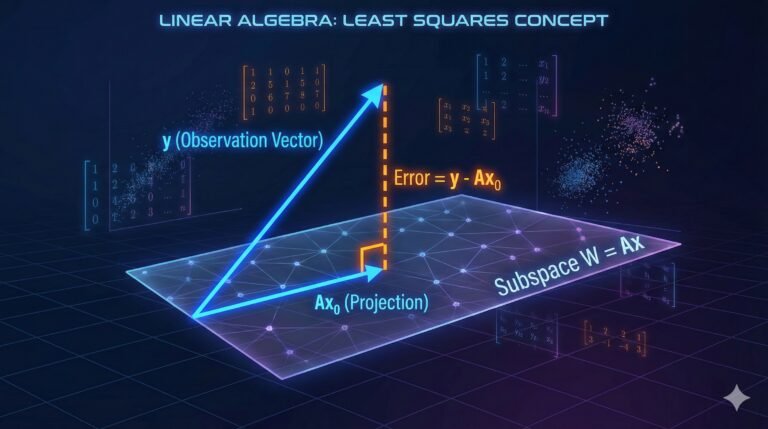
A Linear Algebra Approach to Least Squares

A 3D mathematical visualization showing a vector 'y' outside a planar subspace 'W'. A dashed line representing the error vector drops orthogonally from 'y' onto the plane to the closest point 'Ax', illustrating the geometric solution to the least squares problem.

In science and engineering, we rarely get perfect data. When we collect measurements \((t_i, y_i)\), they almost never fall perfectly on a straight line due to noise or experimental error. We are usually looking for the “best fit” line \(y…